
Deliver Projects
On
Time & Budget
Plan, track, and collaborate on projects with your team. Task management, Gantt charts, time tracking, and client portals�all integrated with billing.
200+
Projects Delivered
95%
On-Time Delivery
40%
Time Saved
100%
Client Visibility
Complete Project Control
Task Management
Create tasks, assign to team members, set deadlines, and track progress. Subtasks, checklists, and dependencies.
Time Tracking
Log hours per task and project. Billable vs non-billable time. Timesheets and automatic invoicing.
Gantt Charts
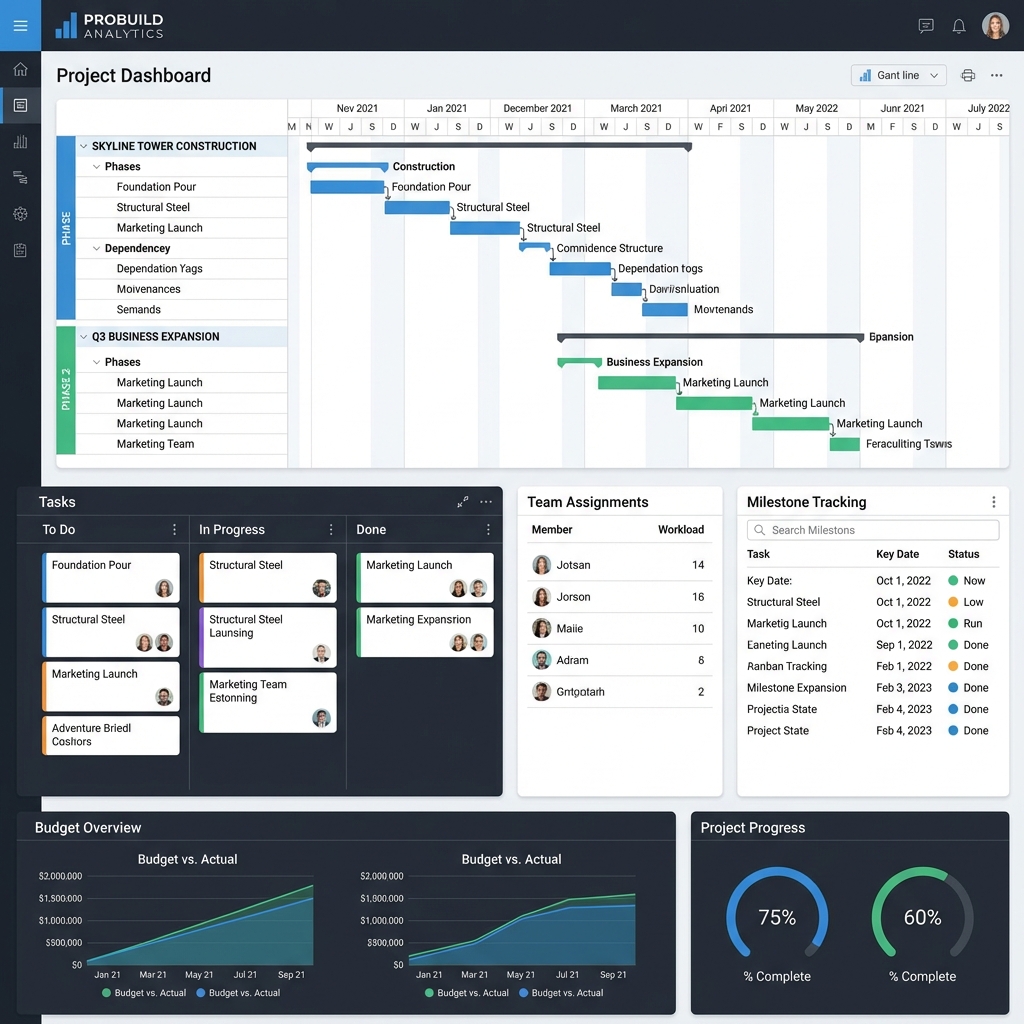
Visual project timeline with milestones, dependencies, and critical path. Drag and drop scheduling.
Resource Allocation
Assign team members based on availability and skills. Prevent overbooking and optimize utilization.
Client Portal
Give clients visibility into project progress. Approve deliverables, view invoices, and communicate.
Budget & Billing
Track project costs, expenses, and profitability. Convert time logs to invoices automatically.
Deliver Better Projects
Join teams using Tawala to deliver projects on time and budget.
Project work in Tanzania has a specific shape
The reason generic project tools disappoint Tanzanian contractors, consultancies and agencies is not the task list. Task lists are a solved problem. It is that the commercial mechanics of a project here — how you get paid, what gets deducted before the money arrives, what you must keep in order to claim it back — sit outside the tool entirely, in a spreadsheet the accountant maintains and the project manager never sees.
The result is a familiar situation: a project that is "95% complete" on the board and has been cash-negative for two months, and nobody realises until the payroll date. Tawala Projects exists to put the commercial reality on the same screen as the delivery plan.
Cost the job, not the month
A project P&L needs four inputs and most businesses only reliably capture one of them.
- Labour. Not salary divided by twelve — actual hours booked to the job, at a rate that includes the employer's statutory load. If a site supervisor costs TZS 900,000 gross, the real cost to the business also carries NSSF at 10% employer, SDL at 3.5% of gross payroll and WCF at 0.5%. Costing labour at bare gross understates every project by a predictable margin. Work out your true loaded rate with the full payroll calculator before you set charge-out rates.
- Materials. Issued from stock at cost, not at the price on the quotation. If materials are drawn from a store, the project should consume them out of inventory so that shrinkage on site shows up as a variance rather than disappearing into general stock loss.
- Subcontractors and expenses. Fuel, transport, accommodation, plant hire, permits. These are the costs that most often get recorded against the company rather than the job, which is exactly why unprofitable jobs look profitable.
- Time actually spent versus time planned. The variance is the early-warning signal. A job that has burned 70% of its hours at 40% completion will not recover; the only question is whether you find out in week three or at handover.
Getting paid: retention, advances and progress claims
Construction and engineering contracts in Tanzania commonly involve an advance payment against a guarantee, progress claims certified at intervals, and retention held back until the defects liability period expires. Each of these breaks naive invoicing.
An advance is not revenue — it is a liability you draw down against as work is certified, and it must be recovered proportionally from later claims. Retention is revenue you have earned but cannot collect yet, and it needs to sit visibly on the balance sheet with a release date attached, because retention that nobody is tracking is retention that is never claimed. A progress claim is not a fresh invoice either: it is cumulative work done, less previously certified, less advance recovery, less retention. Model it wrongly once and every subsequent claim on that contract is wrong.
Where a client withholds tax on service payments, the withheld amount is a credit to you — but only against a certificate you have retained and reconciled. Track it per project rather than per month or you will never match certificates to payments. Our free withholding tax calculator shows how the deduction works, and the cash flow forecast tool is useful for testing whether a payment schedule is survivable before you sign it.
Invoices raised from a project are fiscalised through the TRA Virtual Fiscal Device in the same way as any other sale, so a certified claim produces a compliant document without a separate manual step. VAT at the standard 18% applies where the entity is registered — see the VAT calculator and Finance & VFD.
Fixed price, time and materials, or milestone
The three billing models fail in three different ways, and the system should be set up differently for each.
Fixed price transfers all overrun risk to you, so the only number that matters is cost-to-complete. Track hours obsessively; the moment estimated remaining cost exceeds remaining revenue, escalate. Time and materials transfers risk to the client, so the risk that comes back to you is disputes — which means every hour billed must be traceable to a named person, a date and a task the client recognises. Milestone billing looks safest and quietly kills cash flow, because a milestone that slips two weeks is an invoice that slips two weeks while payroll does not slip at all. If you bill on milestones, forecast cash on the pessimistic date, not the planned one.
Teams that are not in the office
Site teams, field engineers and installation crews work where the connection is unreliable and the device is a phone. Two design consequences follow. Timesheets must be capturable offline and sync later, otherwise they get written on paper and typed up on Friday from memory — which is how a week of labour cost becomes fiction. And approvals must work asynchronously: a supervisor approving from a phone on site, not a manager approving from a desktop three days later. The Tawala mobile app records locally and syncs when the connection returns.
Photographic evidence matters more here than in most markets. A dated photo attached to a task is what settles a dispute about whether work was done before the rains, and it costs nothing to capture at the time.
Who this fits
Building contractors and civil works firms running several sites at once — see the construction industry page for the sector view. Engineering and ICT consultancies billing by the hour, covered further under ICT and technology. Marketing and creative agencies juggling retainers and one-off jobs. NGOs and development programmes that must report expenditure by donor and budget line rather than by month — a reporting requirement that behaves exactly like project accounting. Maintenance and installation businesses whose "projects" are hundreds of small jobs, where timesheets and job cards matter more than Gantt charts.
Projects connects to the rest of the platform: won deals in CRM become projects without re-keying, staff and their loaded cost come from HRM, materials come from inventory, and every cost and invoice lands in Finance so the project P&L and the company P&L are the same set of books rather than two arguments.
Starting up
Do not migrate every historic project. Take the jobs currently in flight, enter them at their present position — contract value, certified to date, advance outstanding, retention held, costs incurred — and run new jobs cleanly from day one. Closed projects belong in your archive, not in a live system where they distort every report.
Projects is available on the higher plans; pricing starts at TZS 25,000 per month overall with no setup fees and a 14-day free trial, and the tier detail is on the pricing page. Useful free templates while you set up: quotation, purchase order, delivery note and service level agreement. If you want to talk through a specific contract structure, contact us.